OSS vs BSS – The Great Divide
🎯 Learning Objective: OSS manages networks and services. BSS manages customers, products, and money. They must integrate seamlessly to deliver end-to-end telecom services. By the end of this article, you will understand the boundary between OSS and BSS, how they interact, and why poor integration causes real business problems.
The Fundamental Difference
OSS – Operational Support Systems
"How the network works"
- 📡 Network devices (routers, gNBs, switches)
- ⚠️ Faults and alarms
- 📊 Performance metrics (latency, utilization)
- 📦 Network inventory (physical + logical)
- ⚙️ Provisioning & activation
- 🔄 Service orchestration
Users: NOC engineers, field technicians, network planners
BSS – Business Support Systems
"What customers buy and pay for"
- 👥 Customers and accounts
- 📦 Products and offers
- 📋 Orders and subscriptions
- 💰 Billing and invoicing
- ⚡ Online & Offline charging (OCS/OFCS)
- 📞 CRM and customer care
Users: Sales, customer support, finance, marketing
Side-by-Side Comparison
| Aspect | OSS | BSS |
|---|---|---|
| Primary Focus | Network operations & service delivery | Business operations & revenue management |
| Core Functions | Fault, Performance, Inventory, Provisioning, Activation, Orchestration | CRM, Order Management, Billing, Charging (OCS/OFCS), Product Catalog |
| Key Questions Answered | Is the network healthy? Is there capacity? Why is service down? | Who are our customers? What did they order? Have they paid? |
| Data Managed | Alarms, KPIs, device configs, topology, resource inventory | Customer profiles, products, orders, invoices, payments, usage records |
| Typical Users | NOC engineers, field technicians, OSS integrators | Sales reps, customer support, finance teams, marketing |
| Integration APIs | TMF639 (Resource), TMF638 (Service), TMF642 (Fault) | TMF622 (Product Ordering), TMF641 (Service Order), TMF678 (Bill Management) |
| Time Horizon | Real-time to near-real-time (milliseconds to minutes) | Near-real-time to batch (seconds to days) |
How OSS and BSS Work Together
End-to-End OSS ↔ BSS Operational Workflow
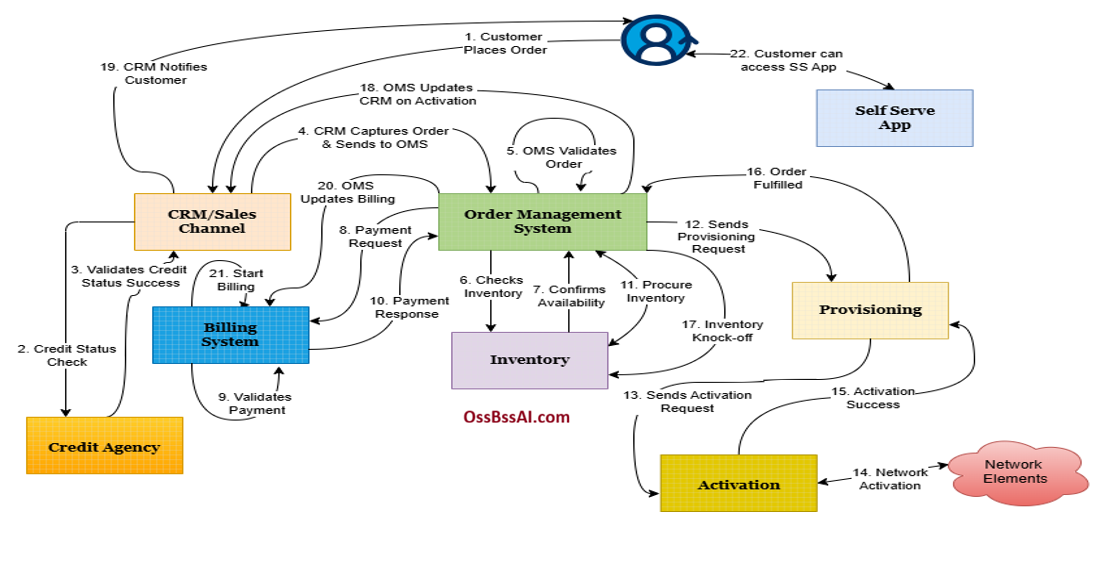
Example telecom operational flow showing how CRM, billing, order management, inventory, provisioning, activation, and network systems interact during customer service fulfillment and activation workflows.
BSS → OSS (Order to Activate)
- Customer selects product in CRM
- Order Management validates credit/eligibility
- Service Order (TMF641) sent to OSS
- Contains: customer ID, product ID, required QoS/SLA
OSS → BSS (Activate to Bill)
- OSS provisions resources and activates service
- Returns service ID + activation timestamp
- BSS starts billing from activation time
- Usage records flow toward charging and billing systems via online or offline charging workflows
Real-World: Customer Activates 5G Service
Scenario: Customer walks into store, orders "5G Premium" plan with 100 Mbps guaranteed throughput
Step-by-Step OSS-BSS Interaction
- BSS - Order Capture: CSR enters customer details, selects product, verifies address
- BSS - Pre-qualification: System checks if location has 5G coverage (may query OSS inventory)
- BSS - Order Validation: Credit check, identity verification
- BSS → OSS (TMF641): Service Order sent with "action": "add", product: "5G_PREMIUM", SLA: "100Mbps"
- OSS - Inventory Check: Verifies available gNB capacity, IP addresses, network resources
- OSS - Provisioning: Decomposes order into service components (5G SA, QoS policy, routing)
- OSS - Activation: Sends commands to gNB, 5GC, UPF, NSSF (network slice selection)
- OSS - Testing: End-to-end service verification (throughput test, connectivity)
- OSS → BSS (Activation Confirmation): Returns service ID, activation timestamp, resource references
- BSS - Billing: Starts prorated billing from activation time, updates CRM
- BSS - Customer Notification: SMS/Email "Your 5G service is now active"
API Integration Examples
Modern OSS-BSS integration uses REST APIs, typically following TM Forum Open APIs:
📤 BSS → OSS: TMF641 Service Order
POST /serviceOrdering/v4/serviceOrder
{
  "id": "ORD-2026-05-09-0012345",
  "customer": {
    "id": "CUST-789012",
    "name": "Bryant Construction Pvt Ltd"
  },
  "serviceOrderItem": [
    {
      "id": "1",
      "action": "add",
      "service": {
        "serviceSpecification": {
          "id": "5G_ENTERPRISE_PREMIUM"
        },
        "serviceCharacteristic": [
          {
            "name": "bandwidth",
            "value": "100Mbps"
          },
          {
            "name": "sla",
            "value": "99.99%"
          },
          {
            "name": "latency",
            "value": "10ms"
          }
        ]
      }
    }
  ],
  "relatedParty": [
    {
      "role": "Contact",
      "name": "Michael Smythe"
    }
  ]
}
📥 OSS → BSS: Activation Confirmation
PATCH /serviceOrdering/v4/serviceOrder/ORD-2026-05-09-0012345
{
  "state": "completed",
  "service": {
    "id": "SVC-5G-88273",
    "activationDate": "2026-05-09T10:30:00Z",
    "state": "active"
  },
  "resourceRefs": [
    "/resource/gNB/TOWER-044",
    "/resource/networkSlice/SLICE-5G-001"
  ]
}
📊 OSS/Charging Domain → BSS: Usage Event
POST /charging/v4/usage
{
  "serviceId": "SVC-5G-88273",
  "customerId": "CUST-789012",
  "timestamp": "2026-05-09T14:23:00Z",
  "usageVolume": 250000000,
  "unit": "bytes",
  "ratingGroup": "DATA_5G_PREMIUM",
  "location": {
    "siteId": "MUM-POWAI-044",
    "region": "Mumbai"
  }
}
What Happens When Integration Fails?
Activation Failures
BSS thinks service is active, but OSS failed to configure network. Customer cannot use service but gets billed.
Revenue Leakage
Service active on network but activation response never reached BSS. Customer uses service for free.
Customer Churn
Network fault impacts customer, but BSS has no visibility. Customer calls support, agent has no answer.
SLA Penalties
Performance degradation not correlated to customer account. Operator pays penalties unnecessarily.
Real Industry Impact
OSS–BSS synchronization gaps can create severe operational and financial consequences for telecom operators.
Revenue Leakage
Lost due to delayed or failed synchronization between OSS provisioning and BSS billing systems.
Annual Financial Impact
Estimated yearly impact for a telecom operator generating approximately $1B annual revenue.
Activation Synchronization
Even sub-second delays between activation and billing systems can create large-scale charging inconsistencies.
Real telecom environments process millions of provisioning, charging, and activation events daily. Even small synchronization gaps between OSS and BSS workflows can result in revenue leakage, incorrect billing, SLA disputes, and customer dissatisfaction.
If You Come from BSS
You already understand customers, products, orders, and billing. Here's how OSS maps to your world:
| BSS Concept | OSS Equivalent | Why It Matters |
|---|---|---|
| Customer Account | Subscriber + Service Instance | Which network resources serve this customer |
| Product Catalog | Service Catalog + Capability Mapping | What network capabilities deliver the product |
| Order | Workflow + Activation Tasks | How the order is executed on network |
| Billing Event | Usage Metric + Rating | What to charge based on network usage |
| SLA / Guarantee | QoS Policy + Monitoring | How network enforces and tracks performance |
| Complaint Ticket | Trouble Ticket + Root Cause | Technical reason for customer issue |
Industry OSS and BSS Platforms
| Vendor | OSS Platform | BSS Platform | Notes |
|---|---|---|---|
| Nokia | NetAct | Nokia BSS (formerly Comptel) | Strong in radio/RAN management |
| Ericsson | ENM / OSS-RC | Ericsson Digital BSS | Leader in 5G core integration |
| Huawei | U2020 / iMaster NCE | Huawei SingleBSS | End-to-end solution provider |
| Amdocs | Amdocs OSS | Amdocs BSS | Strong catalog-driven approach |
| Netcracker | Netcracker OSS | Netcracker BSS | Cloud-native, AIOps enabled |
| Oracle | Oracle OSS | Oracle BSS | Strong in billing and revenue management |
Key Terms You Must Know
Common Questions
Q1: What is the primary difference between OSS and BSS?
OSS manages network operations (faults, performance, inventory, provisioning). BSS manages business operations (customers, orders, billing, CRM). OSS answers "how the network works", BSS answers "what customers buy".
Q2: How do OSS and BSS integrate?
Via APIs, typically TM Forum Open APIs. BSS sends a TMF641 Service Order to OSS. OSS provisions/activates the service and returns confirmation. BSS then starts billing.
Q3: What happens if OSS-BSS integration fails?
Revenue leakage (service active but not billed), activation failures (billed but not active), customer churn (no visibility into network issues), SLA penalties.
Q4: What is TMF641?
TM Forum's Service Order API. It's the standard interface for BSS to send service orders to OSS for provisioning and activation.
Q5: Why do operators struggle with OSS-BSS integration?
Legacy systems, different vendors, inconsistent data models, real-time vs batch processing, organizational silos (network team vs business team).
Q6: What are OCS and OFCS?
Online Charging System (real-time, prepaid) and Offline Charging System (postpaid mediation). OSS provides usage events; BSS/OCS calculates charges.
📌 Key Takeaways:
- OSS = Network operations (faults, performance, inventory, provisioning, activation)
- BSS = Business operations (customers, orders, billing, charging, CRM)
- Integration boundary = TMF641 Service Order API
- Integration failure = Revenue leakage, activation failures, customer churn
- Modern trend = OSS correlates network faults with customer services, not just devices
- From BSS perspective = OSS is the engine that executes what BSS sells
- From OSS perspective = BSS is the customer and revenue interface